
UK Wholesale Electricity Prices: Charts & Market Analysis
These wholesale electricity prices are updated to reflect the power price that electricity suppliers are payingWe tender 30+ suppliers and handle the switch — get a tailored quote.
What is the current UK wholesale electricity price?
As at 24 September 2026, the UK wholesale electricity price is around £147 per MWh for Winter 2026 delivery and around £103/MWh for Summer 2027. That equates to roughly 14.7 p/kWh (Winter 2026) and 10.3 p/kWh (Summer 2027) at the wholesale level, before network, policy and supplier costs are added to a final business electricity bill.
Figures are indicative forward-market levels, updated regularly. Last updated: 24 September 2026.
UK wholesale electricity prices are the prices at which electricity suppliers purchase power on the traded market before adding network, metering and regulatory costs to produce a delivered business electricity bill. Power in the UK is traded in megawatt-hours (MWh), though for most business customers it is expressed in pence per kilowatt-hour (p/kWh) – to convert, a day-ahead price of £80/MWh equals 8p/kWh before non-commodity costs are added. Our chart tracks day-ahead prices (reflecting current market conditions), alongside indicative Winter 2026 (the upcoming peak demand season) and Summer 2027 (the forward market) levels. Prices are primarily driven by gas prices, wind and solar generation output, carbon costs and inter-connector flows.

UK Wholesale Power - Day Ahead Prices
This chart shows the price of electricity on the wholesale market in GB for delivery the next working day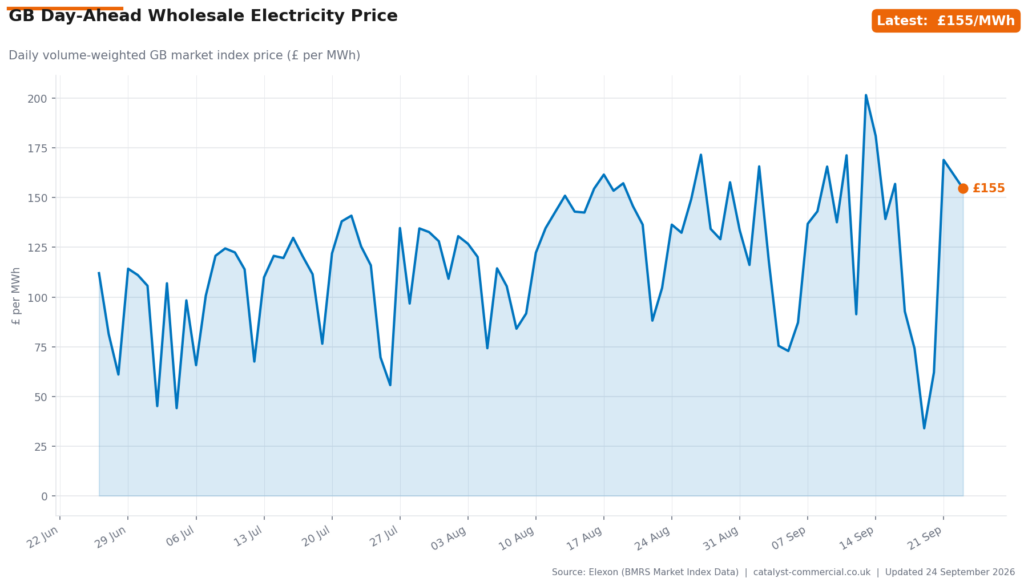
Citing this data
This chart shows the GB day-ahead wholesale electricity price, taken from the APX Market Index Price and averaged across each day’s half-hourly settlement periods, in pounds per megawatt hour. The series comes from Elexon Market Index Data (BMRS) and runs to the previous day.
Please attribute as:
Contains BMRS data © Elexon Limited copyright and database right 2026. Chart: Catalyst Commercial Services, catalyst-commercial.co.uk
Please note: the Winter and Summer season figures shown elsewhere on this page are indicative editorial estimates taken from published market commentary. They are not licensed market data and should not be reproduced as a price series.
Journalists and researchers are welcome to reproduce this chart with attribution. For comment on UK wholesale electricity prices, contact Catalyst Commercial Services.
Day ahead wholesale electricity prices are available for delivery the next working day and typically reflect the true market rate as the conditions that make up the price are not influenced by long term events. Day-ahead electricity prices can vary depending on a number of factors, including the demand for electricity, the supply of electricity, and the cost of generating electricity. Prices may be higher during times of high demand and lower during times of low demand. wholesale electricity prices may also be influenced by factors such as the availability of different types of electricity generation, such as renewable energy sources like wind and solar, as well as the cost of fuel for traditional generation sources like coal or natural gas.
Latest Energy Market Reports
All the latest UK energy market price news and views-

UK Energy Market Report – 25 Sep 2026
UK gas and power market update, 25 September 2026. All 33 gas, baseload and peak contracts settle higher and Britain is no longer the cheapest hub.
-
UK Energy Market Report – 24 Sep 2026
UK wholesale gas and power market update, 24 September 2026. Nine of eleven NBP contracts fall and day-ahead power settles lower for a second day.
-
UK Energy Market Report – 23 Sep 2026
UK wholesale gas and power market update, 23 September 2026. Gas recovers part of the 21 September fall as day-ahead power drops 18 per cent.
-
Weekly Energy Market Report – Week 39
UK weekly wholesale gas and electricity market summary for 16 to 22 September 2026: NBP gas prices, day-ahead power, Brent crude and buying guidance.
UK Wholesale Electricity Prices - Season Ahead Prices - Winter 2026
Forward season-ahead power for delivery in Winter 2026/27 - the period businesses buy at renewalUnlike other markets that use a forward curve for pricing contracts for delivery at different points in time, the fact that wholesale electricity prices cannot be stored means that the traditional methods of pricing a forward contract (i.e spot price plus net carry) do not apply. As a result expected levels of supply and demand determine the forward price in £/MWh.
UK Wholesale Power - Summer 2027
The next front Summer seasonSummer 2027 forward electricity prices reflect the market’s expectation for the supply-demand balance across the less demand-intensive summer months. These prices are typically lower than winter prices as heating demand falls and solar generation increases, though low-wind periods can still push day-ahead prices sharply higher when gas sets the marginal cost. Businesses using flexible electricity purchasing can use the summer-ahead price as a reference point when building a forward position ahead of the Winter 2026/27 peak demand season.
Are UK wholesale electricity prices falling in 2026?
UK wholesale electricity prices have fallen significantly from the record highs of 2022, but remain above pre-crisis levels in 2026. Prices continue to fluctuate daily based on gas prices (which set the marginal cost of power), wind generation output, demand, and interconnector imports from Europe. Our wholesale electricity price charts are updated regularly to show current market direction.
What drives UK wholesale electricity prices?
UK wholesale electricity prices are primarily driven by gas prices (gas-fired power stations set the marginal price in most settlement periods), wind and solar output, demand levels, carbon prices, and interconnector flows from France, Belgium and Norway. In periods of high renewable generation, electricity prices can fall sharply; in low wind periods with high demand, gas sets the price and costs rise.
What affects electricity prices in the UK?
Several key drivers influence both short-term and long-term UK wholesale electricity prices: gas prices, renewable energy output (wind, solar), demand patterns, carbon allowance prices under the UK Emissions Trading Scheme, interconnector capacity from Europe, and geopolitical events affecting energy supply chains. Currency fluctuations can also impact the cost of imported energy.
What is the UK wholesale electricity price?
The UK wholesale electricity price is the price at which electricity trades on the wholesale market for various delivery periods - within-day, day-ahead, month-ahead, season-ahead and year-ahead. Suppliers purchase electricity at wholesale prices and pass costs on to business customers through their energy contracts. Our chart tracks day-ahead prices, with indicative season-ahead levels, updated regularly.
How can businesses reduce their wholesale electricity cost exposure?
Businesses can reduce exposure to wholesale electricity price volatility through fixed-price contracts (locking in rates at contract renewal), flexible purchasing strategies (buying electricity in tranches when market prices are favourable), or Power Purchase Agreements (PPAs) for renewable energy. An experienced energy consultant can advise on the right strategy for your consumption profile.
Electricity Prices In UK
What goes into the electricity price in the UKThe price for electricity UK wide is typically priced based on various factors, and the structure can be quite complex. We look at some of the key components that influence electricity pricing in the UK. First of all, we must look at the wholesale market prices. The wholesale market is where electricity generators sell their power to suppliers. Prices in the wholesale market can fluctuate based on supply and demand, weather conditions, fuel costs, and other market dynamics. The wholesale market is responsible for the daily fluctuations in the UK electricity price. With different time frames associated with different buying periods, for example day-ahead electricity prices are for those companies large enough to have a flexible energy contract and who want to buy energy today for delivery tomorrow. Those that typically have a fixed price energy contract, their prices will be made up of a combination of seasonal prices to give a final wholesale price to the energy element of the bill. The price of electricity UK wide is often traded as a commodity in the futures market. The electricity futures market allows producers, consumers, and traders to buy and sell contracts that specify the future delivery of a certain quantity of electricity at an agreed-upon price. These futures contracts help market participants manage the risk associated with fluctuating electricity prices on a daily basis. Another large element for the final delivered UK power prices, is transmission and distribution costs. These are the costs associated with transporting electricity from power plants to end-users through the transmission and distribution networks. The costs depend on the distance between the power source and the delivery point. The final power prices UK wide will have an element of the transmission and distribution costs associated with them, all dependent on the location of the meter in relation to the supply points. Regulatory charges and various renewable taxes imposed by the government can also contribute to the overall electricity price. This may include environmental levies, carbon taxes, and other fees aimed at supporting renewable energy or addressing environmental concerns. These costs contribute the largest element now to a fully delivered energy bill outside of the wholesale price of electricity. In addition to this, the costs associated with metering, billing, and administrative processes can also be factored into the final delivered electricity prices, along with capacity charges. Capacity charges cover the costs associated with maintaining the capacity of the electricity grid to meet peak demand. It includes the costs of maintaining and upgrading the infrastructure to ensure a reliable power supply at all times. It is the combination of these factors when added together provide a fully delivered energy bill. It’s important to note that residential, commercial, and industrial customers may have different tariff structures, and prices can vary among energy suppliers as their price to serve and the level of support that they provide to a customer will dramatically alter their required margin within a product.
The UK wholesale energy market: how gas and electricity prices connect
Wholesale energy usually means both fuels bought on the traded market before delivery costs are added: gas priced in pence per therm, electricity in pounds per megawatt hour. Most businesses buy both, and the two markets are closely linked, so it is worth reading them together rather than one at a time.
The link runs through generation. Gas-fired power stations frequently set the marginal price of electricity in Great Britain, which means the wholesale price of gas and electricity tends to move together. A cold spell, an outage on a gas interconnector or a run of low wind will usually show up in both curves rather than one. That is why our daily view of the wholesale gas price matters even to a buyer who only purchases power.
Two things follow for anyone tracking the UK wholesale energy market:
- Compare the same delivery period. A day-ahead price and a season-ahead price answer different questions. Day-ahead tells you what the system is doing now; the forward curve is what you can actually contract at.
- Wholesale is not your bill. Wholesale energy costs are the commodity only. Network charges, policy costs, the Climate Change Levy and supplier margin sit on top, and those are regional and largely fixed regardless of where the market trades.
Our energy market reports cover both fuels together, and set out what has moved and why.
UK Wholesale Electricity Price Outlook 2026
UK wholesale electricity prices in 2026 are shaped by an energy market in transition – moving away from gas dependence towards renewables, while still heavily influenced by gas-fired generation during low-wind periods. Key factors influencing UK wholesale electricity prices include:
-
Gas prices – Gas-fired power stations remain the marginal generator across much of the UK electricity market. When gas prices rise, wholesale electricity prices follow. The link between UK gas wholesale prices and electricity prices is one of the most significant drivers.
-
Wind and solar generation – The UK has significantly increased renewable capacity. High wind output can push wholesale electricity prices to very low levels; calm periods push prices higher as gas fills the gap.
-
Carbon price – The UK Emissions Trading Scheme (UK ETS) carbon allowance price adds to the cost of fossil fuel generation and therefore feeds into wholesale electricity prices.
-
Inter-connector capacity – The UK imports and exports electricity via inter-connectors to France, Belgium, Norway and Denmark. Constraints or high European prices affect UK wholesale electricity prices.
-
Demand patterns – Industrial and commercial demand, seasonal heating and cooling needs, and the growth of EV charging all influence the daily demand profile and therefore wholesale electricity price levels.
Our wholesale electricity price chart tracks UK day-ahead prices, with indicative season-ahead levels, giving energy buyers an up-to-date view of market direction. For tailored business electricity procurement advice, contact Catalyst Commercial today. For the latest wholesale electricity price movements and daily market analysis, read our UK energy market report September 2026. For a full month in review, read our Aug26 Energy Market Brief, covering the nuclear outages that lifted Winter-26 baseload from £99.60 to around £121 per MWh.
Further reading: business electricity rates shows what gets added to this wholesale figure before it reaches a business bill.
Start with a no-obligation business electricity quote from Catalyst.
Want these numbers applied to your own contracts?
We publish these figures every week. If you want to know what they mean for your renewal, your budget or your hedge position, we will review where you stand and tell you honestly whether there is anything worth doing. No charge and no obligation.